Day – 8 (12/11/2024)
Our seventh and eighth day's itinerary: Gopeswar, Vaitarni, Tunganath, Anirudh Temple, Vishwanath Mandir, Maa Kali, Maa Tripura Sundari Lalita Mayi Mandir, Narayan Koti, Mundkatiya, Kalimath, Triyugnarayana, Agastymuni, Rudraprayag.
A recap of the seventh day's places of visit: Mundkatiya, Triyugi Narayana, Narayan Koti, Vishwanath Mandir, Kali Math, Anirudha Temple and night halt at Rudra Prayag.
Plans for the seventh and eighth days: Rudra Prayag, Baghnath, Baijnath, Satyanarayan Temple, Patal Bhuvaneshwar, Jageshwar Dham, Katarmal Sun Temple, Aadi Badari. Of these, we visited only Rudra Prayag (for a holy dip in the confluence) and Aadi Badari on Day 7.
Welcome to the ringside seat of our Day 8 visit.
This morning a thick fog welcomed us as we started off
around 07h00 to the temple, around 10 minutes away from where we stayed.
Katarmal is known for a relatively rare Surya temple, constructed by the Katyuri Kings in the 9th century CE and bears witness to the architecture of the day. Masons of the time used a mixture of lime and lentil paste to make the adhesive agent. Katarmalla, a Katyuri king, constructed the temple, which has 44 smaller temples around the main deity of Surya, called Burhadita or Vraddhaditya. Other deities like Shiva-Parvathi and Lakshmi-Narayana. are also established in the temple complex. The carved wooden doors and panels were transported to the National Museum, Delhi, after an idol from the 10th century was stolen. The temple, which holds other carvings on the walls and panels, was declared a monument of national importance under the Ancient Monuments and Archaeological Sites and Remains Act of 1958.[1]
The
temple is under the care and control of the Archaeological Survey of India. It has
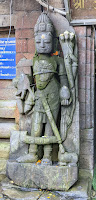
a huge idol of Surya and other idols from the temples flanking the main temple.
Many tourists from all over the world come here for meditation and other health
treatments, in addition to visiting this place.
Plaques describing the Sun Temple
The Majestic Sun Temple
After breakfast of hot aloo parathas, pickles and curd, we
had tea and left for our next destination, Jageshwar Dham. Jageshwar Shiv
temple is one of the oldest Shiva Temples in India, located in Jageshwar town, 36 km
northeast of Almora in the Kumaon Region.
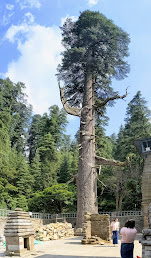
This site has a lot of temples surrounded by Deodhar trees
in the valley. Main temple is of Jyothirlinga Jageshwar Nagesham Daruka Vanam, Maha Mrityunjaya and Pushti Devi
(where it is believed that the ring toe of Sati Devi fell here) when her body
was cut by Sudarshana Chakra of Lord Vishnu.
Jyothirlinga Jageshwar Maha Mruthyunjay Temple
Maha Mruthyunjay Temple 


Various views of the Jageshwar Mandir Samuh (Complex)
Kubera Temple close to Jageshwar Temple Samuh
We performed our pooja rituals here too and then left for our next in the itinerary, Patal Bhuvaneshwar, racing against time as the cave was scheduled to close at 16h30. Suma Aunty contacted and pulled a
few strings so that we reached here just before the closing time. In fact, we were the last ones to
climb into the cave. We deposited the mobiles for safekeeping as no mobiles are allowed inside the cave. There is a nominal fee of Rs 50/- per person and an additional Rs.50/- for a guide (who is a priest too) as without him, it is difficult to understand various aspects of the cave.
A bit on this place:
Patal Bhuvaneshwar is a limestone Hindu cave temple 14 km from Gangolihat in the Pithoragarh district of Uttarakhand state in India. It is located in the village of Bhubneshwar. Legend and folklore have it that this cave enshrines Lord Shiva and thirty-three koti demigods [33 Koti, In Hindu numerology "Koti" means "Crore"]. The cave is 160 m long and 90 feet deep from the point of entrance. Limestone rock formations have created various spectacular stalactite and stalagmite figures of various hues and forms. This cave has a narrow tunnel-like opening which leads to many caves. The cave is fully electrically illuminated. Built by the flow of water, Patal Bhuvaneshwar is not just one cave, but rather a series of caves within caves.
"He who wants to feel the presence of eternal power should come to the sacred Patal Bhuvneshwar situated near the confluence of Ramganga, Sarayu and Gupt-Ganga." - As written in Manaskhanda, Skanda Purana, whose 800 verses refer to Patal Bhuvaneshwar.
I can go on and on describing this place. For more information on this place, you can check the reference point of Wikipedia mentioned in the footnote.
It is said that the cave was closed for ages with a slight prediction in the Skanda Purana that it will be reopened again in Kali Yuga. In the Kali Yuga, Adi Shankaracharya, during his visit to the Himalayas discovered this cave. Since then regular worship and offerings have been done at this place.
There are four entrances inside the cave named ‘Randwar (Door of War)’ ‘Paapdwar (Door of Sin)’, ‘Dharmdwar (Door of Dharma) ’ and ‘Mokshadwar (Door of Moksha (liberation)’. The Paapdwar, literally the Door of Sin, was closed soon after the death of Ravana in the war of Lanka and the Randwar, literally, the Door of War, was closed down after the great Mahabharata War at Kurukshetra. At present only two gateways are open (The Dharmdwar and Mokshadwar gates). You can see the tongue of Kalabhairava, the Airavata of Indra, the Jata of Lord Shiva and several other wonders inside the caves of Patal Bhuvaneshwar.
In the Dvapara Yuga, this cave was rediscovered by the Pandavas. In the Kali Yuga, Adi Shankaracharya consecrated this cave temple and since 1191, this has been a place of visit, both for sightseeing and worship.[2]
A mystifying certainty is that every God or Goddess you
might have heard of dwells in Patal Bhuvaneshwar.[3]
There was a video of the cave circulated freely on WhatsApp but I couldn't upload it. The description of the shared video said that it was of Pashupatinath Temple in Nepal. Since I have seen Patal Bhuvaneshwar, I can vouch that the location is here and not in Nepal as claimed in that video. There are a couple of videos available on YouTube as well.
Our experience:
The only option to see this magnificent beauty of nature is to climb down the narrow passage of the cave. Step down the natural and uneven stone steps and at times, slide down the rocks (with so many people getting down the rough rocks over the centuries, they have smoothened off and one can easily slide down) and holding on to the chains anchored on each side of this narrow passage, squeezing between two huge boulders, twisting and turning your body and all the while minding your head, you will reach the floor level of the cave and get ready to be treated to a fascinating world. This is the only way into and out of the marvelous cave.
The cave is well-lit and at points of interest obscured by light, the priest switched on a powerful torch.
I have made a sincere effort to explain the scene of the Brahmanda out there and I'm sure it won't be even a speck of what one can experience, being present inside the cave! Anyway, I will try and here it goes.
For ease of description, I will divide the cave into Right and Left sides.
Once on the ground of the cave, lifting our heads, we can see the spread of the thin rock-like roof midway between the ground and the cave's roof. This is in the shape of multiple connected hoods a la Adi Shesha the bearer of Lord Vishnu. Here he is bearing the entire cave on his hoods and this is just the beginning.
A look down on the ground, we can see a plait-like formation which, the priest explains, is the body (long tail) of Shesha. This runs for quite some distance on the floor.
Looking to our right a bit higher than the level of your eye, we can see four small stump-like formations. The first three are way smaller than the fourth one and each of them represents an Eon (Yuga). Of the three, the smallest one is in front of the fourth, a bigger stump. It is believed that Kaliyug ends once the fourth stump touches the roof.
Glancing to our right, we saw umpteen leg-like formations and the priest explained that these are the thousand legs of Airavata, the divine elephant.
A bit further, the priest showed us Lord Ganesh's head as it was cut off by Lord Shiva. There is a Brahma Kamala flower-like formation from where the water kept flowing onto where the head was and waited till the head of the elephant was brought to be affixed. It is dripping water to this day as we saw it.
A bit further, on the left side, there is a formation depicting the heavenly flowering tree ' Parijatha'. Near this, there is a small pond with water and we can see countless pebbles closely fixed like a mat, representing 330 million Gods. We did Abhisheka on them using the water from the pond. Vishwakarma - the heavenly sculptor and architect's hand can be seen on the wall above the Kunda.
Thereafter, continuing on the left side, I was flabbergasted to see Shiva's long Jata in brownish-grey and white strands, stretching from the ceiling to more than midway to the floor, of the cave.
On the right side, we can see the three holy places, Badarinath, Kedarnath and Amarnath's Shiva Linga. A tad further, again on the right side, we can see Kalabhairava's tongue.
At a glance on the left wall, at about 10-12 feet high, there is a small hole-like formation that can house a person in a sitting posture. The priest showed us using his powerful torchlight, and we beheld the shadow of a human sitting in a yogic state. It is said that this is the shadow of Sage Markandeya, who still exists here to date.
Continuing on the right, the next to be beheld is the asana (seat) of Lord Shiva and the formation of Goddess Bhuvaneshwari's image with a spear held in one hand and her Simha Vahana. She is the protector of this Patal Bhuvaneshwar (actually, the name of this cave is Patal Bhuvaneshwari but over time the name has been shortened to Bhuvaneshwar).
Further ahead, again on the right side, there is a figure of a swan formed of a rock, with its head turned away from the wall, where Amrit (Heavenly Nectar) is found. Legend has it that the swan was given the responsibility to guard this and it couldn't resist the thought of tasting the nectar. Lord Brahma came to know of its intention and cursed it to turn its head and see the other way.
At this point, the tail of Adishesha ends and the passage leads to the Shiva Linga which is believed to have been installed by Adi Shankaracharya. Since the Linga was unbearably hot, it is believed that Acharya had it copper-clad. The Linga has crystal forms of the Trinity (Brahma, Vishnu and Maheshwar). A bit higher on the wall of the cave, we can see the Swayambhu (self-formed) idols of Brahma, Vishnu - sitting on Garuda and Maheshwara. Divine presence can be felt here as water keeps dripping only on the idols of Vishnu and Shiva but not on the idol of Brahma (as Brahma is not worshipped).
We did abhisheka with water, milk, ghee and honey to the Shiva Linga, adorned it with Vastra, offered naivedya and performed Aarati as well, as a part of our pooja rituals as was done at all the temples.
As alluded, there are caves within this huge cave and one of them leads to Kailash Parvath, the other to Badarinath, the third to Kedarnath and the fourth one to South India. It is believed Pandavas used this cave to proceed to Badrinath on their way to heaven and Adi Shankaracharya used to travel through this cave.
Phew! This was, perhaps, my best effort in remembering, (with Suma Aunty's input and assistance) all that we saw inside the mystic cave and explaining the same in words. It would have been easier had we been allowed to take pictures there, as it is said that a picture is worth a thousand words. My description of the cave comes close to it (774 words to be precise). Well, I tried!😌
Negotiating the cave was probably the most testing part for one’s agility, flexibility and fitness to slither into the cave and return. Only 10 persons are allowed at a time so that the cave’s available oxygen can sustain the crowd. There are oxygen generators at the start and inside the tunnel to assist those in need.
Below collage of pictures from the mystic cave, courtesy of the hotel where we had tea, just outside of the cave. Such laminated pictures were on sale at the shops that were closed when we came out of the cave.
Collage of pictures showing different views of the mystic Patal Bhuvaneshwar cave
By the time we came out of the cave, it was already dark and
we were exhausted. All of us wanted to stay back for the night at this place
but couldn’t get any accommodation. So we hopped on to the nearest town Choukri
(I had a chat with Sanjay, our reliable driver who, despite being tired agreed
to drive on for another hour to this place). The rooms at this place were
perhaps the best and biggest so far in our trip.
Exhausted, we had our dinner and called it a day.
Plan vs. Actual:
Visited Katarmal Sun Temple, Jageshwar Dham & Patal Bhuvaneshwar as planned for today. Baghnath, Baijnath and Sathyanarayana Temple has been rescheduled for day 9.
----------------------------------------
Camp coordinates: Hotel Himshikhar Address: Bageshwar-Munsyari Rd, Chaukori,
Uttarakhand 262531 Phone: 084778 36706
https://maps.app.goo.gl/Xf5MJAGMJBCrBnGF9
-----------------------------------------
Continued .... in Part 9
[1] From the website https://en.wikipedia.org/wiki/Katarmal[2] From the website https://en.wikipedia.org/wiki/Patal_Bhuvaneshwar
From the website https://liamtra.com/blog/the-myths-and-mysteries-of-patal-bhuvaneshwar