Search This Blog

Thursday, November 28, 2024

My First Badari Yaatra - Part 6 - 10/11/2024

 Day - 6 (10/11/2024)

Our fifth and sixth day's itinerary:  Gopeswar, Vaitarni, Tunganath, Anirudh Temple, Vishwanath Mandir, Maa Kali, Maa Tripura Sundari Lalita Mayi Mandir, Narayan Koti, Mundkatiya, Kalimath, Triyugnarayana, Agastymuni, Rudraprayag. 

A recap of the fifth day's places of visit: Vrudha Badari, Kalpeshwar Mahadev Cave Temple, Dhyana Badari, Gopeshwar Gopinath Temple and night halt at Sersi, Phata close to Sitapur to visit Triyug Narayan Temple the next day.

Plans for the sixth day: Anirudh Temple, Vishwanath Mandir, Maa Kali, Maa Tripura Sundari Lalita Mayi Mandir, Narayan Koti, Mundkatiya, Kalimath, Triyugnarayana, Rudraprayag. 

Hop in with us, for a virtual tour of our Day 6 activities.

The next day, we visited the Mund Khatiya temple nearby. This is the only temple of its kind as the idol of Lord Ganesh is sans his head. It is believed that Lord Shiva cut off the head of Lord Ganesh, who was guarding Goddess Parvathi while she took a bath in Gauri Kund. As usual, we performed Naivedya, Aarti and donned the Vastra on the deity. 


Our next stop was Triyugi Narayan (on Sonprayag Road), which we traveled by a smaller vehicle, again.

This magnificent temple dedicated to Lord Vishnu, lies in the village of Triyuginarayan, on the ancient bridle path that connects Ghuttur to Shri Kedarnath. It is similar in architectural style to the temple of Kedarnath making this village an important pilgrimage centre. According to a legend, Triyuginarayan was the capital of the legendary Himvat and is the place where Shiva wedded Parvati during the Satyug. the fire for the divine wedding was lit in the huge four-cornered Havan Kund. All the sages attended the wedding of which Vishnu himself was the master of ceremonies. Remnants of that celestial fire are believed to be burning in the Havan Kund even today. Pilgrims offer wood to the fire that has seen three Yugas hence the name TRIYUGINARAYAN. The ashes from this fire are supposed to promote conjugal bliss. There are three other kunds in this temple complex; Rudra Kund, Vishnu Kund and Brahma Kund. These are Kunds where the Gods bathed at the time of Shiva-Parvati wedding. The water in these kund flows from the Saraswati Kund which is said to have sprung from Vishnu’s Navel. Women seeking children bath here, believing that it cures infertility.[2]

The Brahma Kunda is where you wash your hands/feet, the Vishnu Kunda - is where you have a sprinkling (prokshane) of its water on yourself and the Rudra Kunda - is where you offer tarpana to the forefathers. 

            
                                        Brahma Kunda

            
Vishnu Kunda (foreground) & Rudra              Eternal (Akhanda Dhuni) Holy Fire 
Kunda (in the background)

            
              Rudra Kunda for offering Tarpana                 Place of Divine Marriage

          
                                        Lord Ganesha                        Lord Shiva and Maa Parvathi
This temple is also known as the 'Akhand Dhuni' temple where an Akhand (eternal) Dhuni (flame) burns even to this day. 

It is also believed that daughters of marriageable age will get married if their parents or other well-wishers pray here. Also, the marriage bond gets stronger if married couples go around the eternal sacred fire, seven times. Sumithra and Dwarkanath had the opportunity to go around the fire here and renew their vows. We could see a lot of young couples exchanging vows here as it is also well-known for the destination marriages of the Hindus in the Northern part of India.

After a tea break, we visited Narayana Koti in Gupt Kashi. We had to climb down through a labyrinth of stairs and through the fields to make it to the temple. Flanked by Navagrahas (rarely found individual temples for each Graha exists here), Annapurna Devi and other deities, we reached the ancient Narayana Temple, where it is believed that Lord Krishna gave darshana of ten million (one Crore) forms of himself to Pandavas. Lord Veerabhadra temple and Pandavas idols too co-exist here.

We offered Vastra, and Bead Garland, performed Aarti to Lakshmi Narayana idol here and dropped off the abhisheka items with the caretaker for the next day's abhisheka.

         
Lakshmi Narayana carried by Garuda
             
                                                     Sun                    Moon                   Mangala    

                  
Bhuda                 Guru                     Shukra

            
                                            Shani                        Rahu                       Ketu

The temple group is said to have been built before the 9th century AD. From time to time, due to the impact of disasters and lack of care, now there are only 29 temples, whereas in the past there were 360 temples in groups. Two streams of water of water Ganga-Yamuna flow into the stone tank called Brahma Kund or Veerabhadra Kund.[1]

We filled the refreshing water in our bottles from this flow. A group of kids who chaperoned us were given tips and in return, they offered us lots of Sweet Lime (Mosambi, as we call it here) for us to carry. So sweet of them! We blessed them and resumed our journey.


Our next stop was Vishwanath Temple in Gupt Kashi. Built on similar architecture of other temples in the province including the famed Kedarnath temple, this has a striking resemblance to the Vishwanath Temple at Kashi too. Legend has it that Lord Shiva proposed to Goddess Parvathi at this place. Here too, the two streams of water Ganga-Yamuna flow into a stone tank in front of the temple. Another legend has it that Lord Shiva didn’t give darshan to Pandavas as he was upset that they killed their kith and kin in the Mahabharata war. Pandavas did penance to please Goddess Parvathi to cajole Lord Shiva to grant them darshana. Lord, half-mindedly gave darshana to them in the form of Ardhanarishwara. A small shrine dedicated to this deity.


Thereafter we had lunch and proceeded towards the powerful Kali Math. The temple is located in Kalimath village in Rudra Prayag District on the banks of Saraswathi River and one of the 108 Shakti Peetas as per Shrimad Devi Bhagawata. The railings were adorned with bells and again a steep climb down to reach the bridge across the River Saraswathi.

According to Hindu mythology, Shakti Peethas are the holy abodes of Goddess Shakti (the consort of Lord Shiva), where parts of her body fell on Earth. The Kalimath Temple stands on the spot where the Goddess's feet are believed to have fallen and according to legend, Goddess Kali disappeared into the ground in Kalimath after defeating the demon Raktabhija. The temple was built around the spot where she disappeared, and an engraved Sri Yantra on a silver plate covers the ground to symbolize her presence. The plate is only opened once a year during Navratri when the chief priest performs a midnight puja. Her face is in Maa Dhari Devi temple, some 20 km before Rishikesh. Goddess is worshipped here in the form of Sri Yantra. 

     
Maa Kali in the form of Sri Yantra

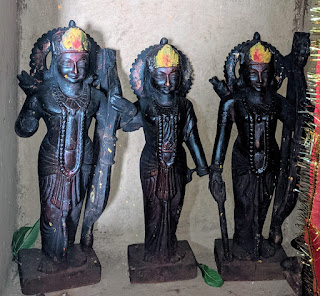
Rama, Sita and Lakshmana

           
Oher idols found in the temple

Lord Shiva and Maa Parvathi facing each other

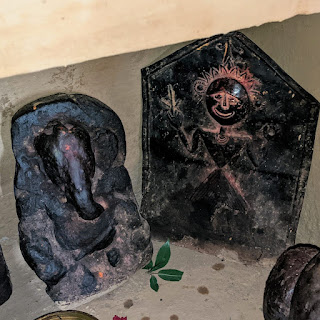
Lord Ganesha and Surya


Other idols found in the temple

         
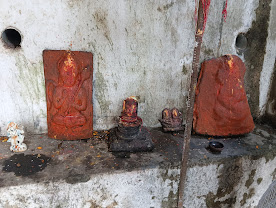
                        Maa Kali and Lord Ganesha                    Other temples in the complex

There is an eternal lamp that has been lit up and burning for centuries, it is believed. It is also the birthplace of the famous Sanskrit poet, Kalidasa.

It is said that we can meditate here with concentration and develop and enhance the potential of our knowledge of various mantras. I was taught a mantra by my Guruji a decade ago and had forgotten about it. So, I decided to renew my knowledge by meditating here but I couldn’t remember the mantra at the first go. I went out of this temple into the complex and saw other temples and in the meantime tried to remember the mantra. Fortunately, I could and then went back into the sanctum and began meditating for about 10-15 minutes with all concentration. I could find some change in me on completion of this process.

Throughout the trip in our 'Limousine', we were constantly fed with something or the other to munch - be it Suma Aunty's/Sumithra's dry fruit laddus, Peanuts, Jackfruit/Banana chips, Chakkli, fruits, etc. We sustained for a long time, without any snack/lunch break. Tea breaks were at our convenience.

Our next stop was Anirudha temple at Ukimath, around 19 km from Kali Math, off Guptakashi-BasuKedar Road. This beautiful temple is dedicated to Anirudha, grandson of Lord Krishna. He was captured by Banasura in retaliation for loving his daughter Usha. The place where Anirudha was imprisoned could be seen from Banasura's palace across the temple. The place Ukimath was previously known as Ushamath and gradually got this name. Utsav Doli of Lord Kedarnath and Madhymaheshwar reside and are worshipped for six months starting from the winter when these temples close. Our ritual of pooja continued and we had a chat with the priest here too.

                                                                    Idol of Anirudha

Our next halt was for the night, at Rudra Prayag. We stayed at Hotel10 Battalion. Strange name for a hotel, but a comfortable one and we ordered plain rice as we had other stuff to blend it with.  

During that night, I tried my renewed skill on my cousin Sumithra, who had problems with her foot and she said my treatment was effective on her. Inexplicably, I felt elated at this happening and continued to treat her for the next couple of nights. By the time we concluded our trip, she said that her leg was so much better. 

Plan vs. Actual:

Mundkatiya, Triyugi Narayana, Narayan Koti, Vishwanath Mandir, Kali Math and Anirudha Mandir were covered on day 6. Due to the paucity of time, we couldn’t visit other places like Anusuya Temple, Agastya Muni Ashram, Chandika Devi Temple, Vaitarani Dhara, Tunganath, Maa Tripura Sundari Lalita Mayi Mandir.  

----------------------------------------

Camp Coordinates: Hotel 10 Battalion Address: near Indian oil petrol pump, Raintoli, Uttarakhand 
246171 Phone: 089795 55514
https://maps.app.goo.gl/narxg6w2Tx2Le7zb6
--------------------------------------

Continued .... in Part 7


[1] From the website https://www.euttaranchal.com/tourism/narayan-koti-temples.php

[2] From the website https://rudraprayag.gov.in/temples/

Wednesday, November 27, 2024

My First Badari Yaatra - Part 5 - 09/11/2024

Day - 5 (09/11/2024)

Our fourth day's itinerary: At Badari Kshetra, trek to Charan Paaduka, Mana Village (visited the previous day itself), Joshimath Shankaracharya Math and the night halt at Joshimath.

A recap of the fourth day's places of visit: Badari Kshetra, trek to Charan Paaduka, Hanuman Chatti, Pandukeshwar (Yogadhyan Badari), Vishnu Prayag, Joshimath Shankaracharya Math, Bhavishya Kedar and the night halt at Joshimath.

Plans for the fifth & sixth days:  Gopeswar, Vaitarni, Tunganath, Anirudh Temple, Vishwanath Mandir, Maa Kali, Maa Tripura Sundari Lalita Mayi Mandir, Narayan Koti, Mundkatiya, Kalimath, Triyugnarayana, Agastymuni, Rudraprayag. 

Join us, for a virtual tour of our Day 5 activities.

This morning, as was our routine, we started off early, to Vrudha Badari (the fourth of the five Badaris). Vrudha Badari is located at Animath in Chamoli district of Uttarakhand. The Vrudha Badari temple dates back to the time when India was ruled by the Gupta Dynasty. The Vrudha Badari is one of the “Sapta (Seven) Badaris” temples in the Badarikshetra (though only 5 Badaris are prominent. The other two Badaris are Arda Badari - that can be reached only by trekking and Narasingh Badari - The Narasimha Temple at Joshmath). 

The legend of Vrudha Badari says that when the great sage Narada decided to perform penance at this place to please Lord Vishnu, the pleased Lord appeared before Narada disguised as an old man and answered his prayers. It is said that the Lord preached the knowledge of Anima Siddi to the Sage. The idol's face here is that of the elderly Lord, who appeared in front of the sage and hence called Vrudha Badari. The best way to visit the temple (without climbing up) is to get off the vehicle at the entrance of the temple stairways and get the vehicle to come over to the exit (around 2 km on motorable road) down the other way, where you can climb down to get on to the vehicle and conserve your energy for other places where climbing up is imminent.

  
Vrudha Badari

                                                            Temple at Vrudha Badari
Thereafter, we proceeded to Helang from where we negotiated with local taxi operators and engaged a smaller vehicle to go to Kalpeshwar, a distance of around 11 km. River Kalpganga flows below this shrine and one has to cross a hanging bridge to reach the base of the climb to this cave temple. This is one of the Panch (five) Kedaras, where it is believed the Jata (lock of hair) of Lord Shiva exists and can be seen here. Earlier it was approachable only by 12 km (7.5 mi) trek from the nearest road head of Helang on the Rishikesh-Badrinath road but now the road goes up to Devgram village from where the trek is just 300 meters. The road is accessible to bicycles and small cars except during the monsoon season. This too, is a climb (though not a tedious one) that takes us to the cave-like structure where the rocky extension of the cave resembles the face of Nandi, the Bull vehicle of Lord Shiva. We performed our routine rituals as we did in other temples (Abhisheka, et al).


Outside the Shiva cave, many idols are kept, and in one of the above pictures, in a place called 'Pandav Darshan', some of the weapons used by Pandavas are kept.

On our return from this place, we dropped in Urgam village, where a short trek through the fields took us to the fifth Badari of our itinerary - Dhyan Badari, on the banks of the Alaknanda River. The idol of the temple of Lord Vishnu has four arms, in a meditative position made of black stone. This idol is very small in size and a big marble idol is prominently housed in the sanctum sanctorum. The sanctum also houses idols of Shiva and Parvathi. The temple has an image of Lord Vishnu which was founded by Urvarishi. Also, the temple is included in the Panch-Badri list. Panchmukhi Hanuman temple too, exists in the complex. 
   
               Dhyan Badari with and without Alankaara                 Panchamukhi Hanuman

We returned to Helang and proceeded to Pipalkoti and had lunch at a pricey Marwari restaurant. We received the elusive parcel through Suma Aunty's contact Arun Joshi, who helped in reaching the parcel to this place.

Our next stop, Gopeshwar Mahadev or Gopinath Temple, which is an ancient Hindu temple dedicated to Shiva in Gopeshwar, Chamoli District, Uttarakhand, India. It is situated in Gopeshwar village now part of Gopeshwar town. The temple stands out in its architectural proficiency; it is topped by a magnificent dome and the 30 sq ft (2.8 m2) sanctum sanctorum, which is accessible by 24 doors.

The remains of broken idols found around the temple testify to the existence of several more temples in ancient times. There is a trident, in the courtyard of the temple, about 5 m high, made of eight different metals (Ashta Daatu), which dates back to the 12th century. It boasts the inscriptions attributed to Ashokchalla, the king of Nepal who reigned in the 13th century. Four short inscriptions written in Devanagari, which date back to a later period, are yet to be deciphered, barring one. The legend is that the trident got fixed in this spot when Lord Shiva threw it at Lord Kama to kill him. The metal of the trident is not weathered by the elements and this is a wonder. The legend goes that the trident belonged to Shiva who threw it at Kamdeva (The God of Love) to kill him and it got fixed in this spot. It is believed that while brute force can’t move this Trident, the slightest touch by a true devotee can cause a tremor in it. The metal of the trident does not appear to have become weathered by the elements over the century[1].


Trishula of Lord Shiva used to kill Manmatha


After a tea break at Tungnath (the temple was closed for winter on Nov 3rd itself), we stayed at a Hotel in Sersi, Phata very close to Sitapur to visit Triyugi Narayan Temple on day 6.

Plan vs. Actual:

Gopeshwar and out-of-itinerary places Kalpeshwar and Dhyan Badari were covered. Due to the paucity of time, we couldn’t visit other places like Anusuya Temple, Agastya Muni Ashram, Chandika Devi Temple, Vaitarani Dhara, Tunganath, etc. While Anirudh Temple, Vishwanath Mandir, Maa Kali, Maa Tripura Sundari Lalita Mayi Mandir, Narayan Koti, Mundkatiya, Kalimath, Triyugnarayana, etc., were deferred to day 6.  

----------------------------------------

Camp Coordinates: Hotel Shri Hari & Restaurant, Sirshi, Phata, Rudraprayag, NH-109, Kedarnath Rd, Badalpur, Uttarakhand 246471     Phone: 094111 83894

https://maps.app.goo.gl/FF9u8K1D6YgFG2jQA

----------------------------------------


Continued .... in Part 6


[1] From the website https://en.wikipedia.org/wiki/Gopinath_Mandir 

Monday, November 25, 2024

My first Badari Yaatra - Part 4 - 08/11/2024

Day - 4 (08/11/2024)

Our third day's itinerary: Narasingh Mandir, Dronagiri View Point, Bhavishya Badari, Auli Hanuman Mandir, Vishu Prayag, Yogdhyan Badari, Kuber Temple, Badari Kshethra (Shayana Aarti) and night halt.

A recap of the third day's places of visit: Narasingh Mandir, Bhavishya Badari, Mana village and visit to Saraswathi river's origin, Maharshi Vyasa's Gufa and Lord Ganesh Gufa, Badari Kshethra (Shayana Aarti) and night halt there. We rescheduled our visit to Vishnu Prayag and Yogdhyan Badari to day 5 while we dropped others due to paucity of time but did an extra by visiting Mana. 

Plan for the fourth day: At Badari Kshetra, trek to Charan Paaduka, Mana Village (visited the previous day itself), Joshimath Shankaracharya Math and the night halt at Joshimath. 

Hop on to our limousine, with us, for a virtual tour of our Day 4 activities.

Come morning, we went off to our rendezvous with the Pandit who guided us in performing the rites and offerings to our ancestors. The place is called Brahma Kapala and it is believed that the fifth head of Lord Brahma cut off by Lord Shiva, with his fingernails, fell at this place, hence the name. There were others too, performing similar rites to their ancestors. Though there was a place close by known as ‘Tapta Kund’ with a copious flow of hot water, we didn’t have a bath here as it was biting cold and the temperature was in the low single digits. We couldn’t perform the rites per our South Indian tradition as we were forced to wear woolens throughout the event. I must thank Suma Aunty as she was kind enough to accompany us with Sumithra and clicked a few pics while calling our folks back home on video call, for them to see the event.

                                
              Ready for the Rites     Brahma Kapaala where Pinda Pradhana is performed

This done, we had darshan of the Lord before returning to our rooms changed and were off (Sumithra and Dwarkanath stayed back for another darshana of the Lord) on a trek to Charan Paduka. This is a trek approachable from behind the Badarinath Temple, a distance of around 1.7 km, a climb of 110 mts over this distance. It is quite a trek by any means and we huffed, and puffed on our long way, taking intermittent breaks, sipping on precious liquid from our bottles. The altitude compounded the impact of the trek on us. While Radha and Suma Aunty were adept with trekking, youngsters (Anil and I) were trailing behind them. The panoramic view was a beautiful sight, what with the huge Narayana and Nara mountains flanking us and other mountains all around! Neelkant base camp for the trek to the Neelkant mountain is around 9 km from here.

                    Way to Charan Paaduka                  Foot marks of Lord Narayana


Another foot imprint at the back                            Signage                                 Eternal Lamp

At last, we reached the place, which has the foot marks of the Lord on the rock, believed to be the spot, on which Lord Vishnu’s feet touched the ground. It was such a blissful feeling and we felt blessed to bow down to the feet (footprints) of the Lord. We met up with Suman and Srishti here too. Refreshing 'Payasa' was served here by a person who spoke in Kannada with us. There was an eternal lamp burning in a cave behind where he was preparing Payasa. We thanked him for the payasa and then started to climb down.  

Suma Aunty and Radha climbed down in haste as they had to perform naivedya to the Lord before we wound up our trip. Anil and I ambled down leisurely. I filled my water bottle with the cold spring water from the mountains and my God! It was indeed cold and refreshing to drink. We told others that we would wait for lunch, at the restaurant where we had breakfast earlier. 

After lunch, we hastened to the hotel, packed our stuff, loaded it onto the vehicle and proceeded to our next place of visit, Hauman Chatti around 12 km from Badarinath, which is on the right side of the road, on the way to Joshimath.

         
            Hanuman Temple, Hanuman Chatti                                   Lord Hanuman
The significance of this place is that as legend goes, Lord Hanuman in the form of an old monkey lay on the path (well his long tail, at least) of Bheema who went in search of Sougandhika flowers desired by Draupadi. It is at this place that Bheema's pride was crushed by Lord Hanuman, as per Mahabharata.

The priest of this temple said that Tulasi garlands to Badarinath temple are sourced from this place.

Our next stop was Pandukeshwar – also known as Yogadhyan Badari. Around midway between Badarinath and Joshimath, this place was founded by Pandu Raja, father of the great Pandavas. The stairs below the entry arch, by the main road to Joshimath, take you down to the temple complex. The Yogdhyan Badari Temple is as old as the temple of Badrinath. Pandukeshwar is 24 km from Joshimath, it has the Yogdhyan Badari temple one of the Panch Badari. The image here, in a meditative posture, is worshiped as at Badrinath.

            
                                   Information Plaque                                  Pandukeshawara Temple

                                            Yogadhyan Badari                    Vasudeva 

According to the myth, the Pandavas made over Hastinapur to Raja Parikshit and retired here. Also, King Pandu, the father of Pandavas had spent his last days doing penance here before his Nirvana, and hence the name. Some famous copper plates carrying old inscriptions, providing valuable information on the history of the temple and early Katyuri Rajas have been found here. The surrounding region is Panchal Desh better known as Uttarakhand. Suryakund, which is on the top of Milam glacier, is a hot water spring. Here Kunti is said to have given birth to Karna, fathered by Surya. Pandu married Kunti at Pandukeshwar near Sri Badrinath[1].

Suma Aunty bought a Dhaavali (woolen dothi) here. We (Anil, Dwarkanath and I) had picked up the same on our way to Badrinath, the previous afternoon.

Our next stop was Vishnu Prayag. Just by the highway and a short climb down the stairs from the entry arch, you will reach the Lord Vishnu temple at this place. There is also a temple dedicated to Bhootnath Mahadev. 

                        Lord Vishnu                      Confluence of Dauli Ganga and Alakananda

                                                                Boothnath Mahadev 

Here we could see the first of the major five confluences of the rivers that ultimately flow as the mighty river Ganga from Dev Prayag onwards. At this point, it is the confluence of rivers Alakananda (right) and Dauli Ganga (left). This is also the first of the Pancha Prayag. The name of Vishnu is due to the legend. Sage Narada worshipped Lord Vishnu at this place and the Lord appeared in front of the Sage. 

Our next stop was Joshimath (also known as Jyothirmath), where we went to Shankara Matha (a short distance from the main road), had the darshan of Lakshmi Narayana and the amazing crystal Shiva Linga from the period of Adi Shankara, that diffuses different colours when shown to light. Trotakacharya, a disciple of Adi Jagatguru Shankaracharya established Shankaracharya Math under the supervision of Adi Jagadguru Shankaracharya in the 8th century. This is Atharva Veda (one of the four Vedas) monastery and Vedic school where students come from all over the country and world. This complex has a temple dedicated to Maa Rajarajeshwari, too.


                   Lakshmi Narayana Idols     Spatika Linga which diffuses different colours 

Just outside the Matha, there is another temple, ‘Bhavishya Kedara’! Legend says that once the existing Badari and Kedara become inaccessible, Bhavishya Badari and Bhavishya Kedara will become prominent.

        Shiva just outside Shankaracharya Math complex        Durga Maa 

                                Hanuman                                                         Ganesh


Bhavishya Kedar

After having darshana of this ancient monastery, we proceeded to our hotel for the overnight stay and also to reunite with our baggage left behind at this Hotel Neelkanth, on our onward journey to Badarinath. Our dinner (the menfolk) consisted of pulkas, dal and curds while the womenfolk had rice, in addition.

Persistent follow-up by Suma Aunty of the missing parcel, yielded results as it was finally traced and sent to Pipalkoti’s office. We were supposed to collect it from this place the next day.

Plan vs. Actual:

We visited a couple of places more than planned. On the way to Joshimath, we visited Hanuman Chatti, Pandukeshwar (Yogdhyana Badari), and Vishnu Prayag.

----------------------------------------

Camp Coordinates: Hotel Neelkanth - T.C.P. Bazar, Joshimath, Uttarakhand 246443
Phone:+919634367500  
https://maps.app.goo.gl/xiNbXhNfb678Xwqv8
---------------------------------------

Continued .... in Part 5


[1] From the website https://chamoli.gov.in/tourist-place/yogdhyan-badri/

What's in a Name? ... Perhaps Everything!!

  What’s in a Name? The Case for Uniformity Names are more than personal identifiers; they are the foundation upon which official records,...